
Precision cost visibility through activity-level measurement enables better operational decisions and reveals hidden warehouse inefficiencies.
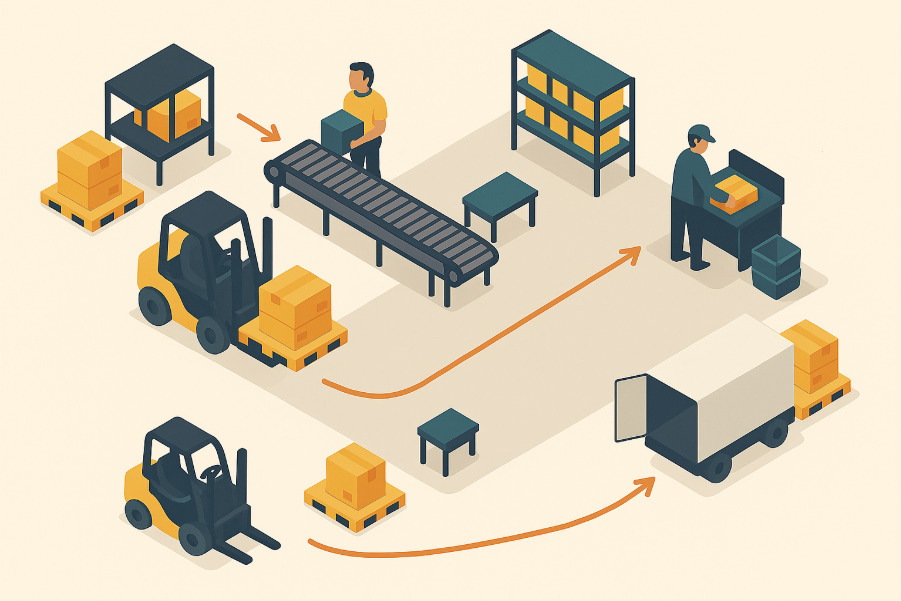
Warehouses that use traditional costing methods are succumbed to inaccurate cost allocation which leads to poor operational decisions and hidden inefficiencies.
Measuring at activity level provides more precise insights on the time taken for each activity. In turn this will gives more precise cost benefits when a certain innovation is applied to improve efficiency in a warehouse.
This article links activity-based costing to Kengrid's strengths in cost control, advanced analytics and invoice validation by demonstrating how ABC produces more accurate cost insights for warehouse operations.
Read the story
The warehousing and logistics industry requires precise cost visibility so that managers can guide staffing, slotting and make service level decisions. By using Activity-Based Costing (ABC), Kengrid provides clarity through analytics-driven cost control, accurate invoice validation and advanced analytics.
By connecting data from receiving, putaway, storage, picking and packing, we expose the hidden inefficiencies and acknowledge the real cost drivers. The result? Better pricing, streamlined workflows and better cost-to-serve across all channels.
How exactly does activity-based costing work? It assigns costs to the operational activities that actually consume resources (e.g., put-away, picking, etc.), which provides expenses that are drastically more accurate than traditional volume-based allocations. Traditional costing masks true costs of different tasks by overlooking services such as labour hours, square footage or shipment counts.
Over time these inaccuracies distort profitability and lead to sub-optimal decisions. The key benefit of ABC is the ability to measure the time taken on every activity. Monitoring and taking action at activity level allows you to reduce the time taken on activities, which in turn reduces cost.
However, ABC is more complex to set up and maintain. It requires detailed activity mapping, clear cost-driver data and constant model governance. These factors often deter many managers despite its known benefits.
Kengrid's cost framework is designed to handle complex operations and calculates costs with speed and accuracy, ensuring every piece passes through each activity such as unload, putaway, pick, pack and load. If any piece is missing, we identify the root cause and eliminate this to maintain 100% accuracy. This also allows any changes in operation to be easily spotted and adjusted.
By adopting ABC costing, warehouses can pinpoint high-cost drivers, redesign workflows more efficiently and optimize labour. This will also allow them to price their services with confidence.
Kengrid's approach keeps tracking models accurate as operations evolve into more data-heavy, automated processes, enabling predictive cost scenarios and continuous improvements without overloading in-house teams.
Activity-based costing is the standard modern warehouses should adopt to replace coarse averages with precise, actionable costs. Yes, compared to traditional methods like volume-based costing, ABC setup and maintenance is considerably more complex, which potentially affects its adoption rate. But in an industry defined by complexity, the benefits of adopting ABC to deliver consistent and precise expense tracking turns cost visibility into a durable competitive advantage and a scalable foundation for the ever-changing future.
Want Kengrid to bridge that gap? Our advanced analytics and cost control framework is purpose-built to make activity-based costing practical and actionable for your warehouse operations.